By Dr. Hamid Bashir & Dr. Shahid Majeed Faculty of Agriculture, UAF | Co-Founders, Royal Organic Honey
In the world of entomology and agriculture, Pakistan holds a unique geographical distinction. Blessed with diverse climatic zones—from the sub-zero temperatures of the Northern Areas to the arid heat of the Thar Desert and the fertile plains of Punjab—our country offers a floral calendar that remains active nearly all year round. This botanical diversity creates a paradise for the genus Apis (honey bees).
For the consumer, however, the journey from flower to jar is often shrouded in mystery. “Is this wild honey?” “Is it farmed?” “Which is better?”
To answer these questions, we must look beyond the marketing claims and examine the biological reality of the bees themselves. As scientists, we believe that understanding the source—specifically the species of bee—is the key to understanding honey quality, consistency, and hygiene.
This comprehensive guide explores the four major honey bee species found in Pakistan, their behaviors, and why we at Royal Organic Honey have chosen Apis mellifera (The European Bee) as the gold standard for restoring trust in the Pakistani market.
Part 1: The Indigenous Bees of Pakistan (The “Wild” Gatherers)
Pakistan is home to three native species of honey bees. For centuries, these bees have been the sole source of sweetness for the region. While they play a critical role in biodiversity and pollination, they present significant challenges for modern, hygienic, and scalable honey production.
1. Apis dorsata: The Giant Rock Bee (Doma or Bari Makhi)
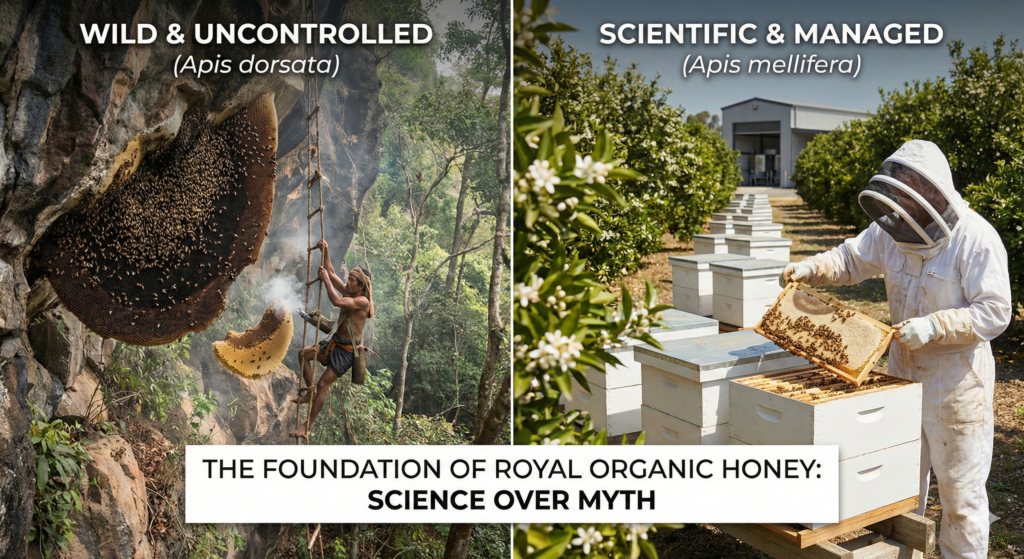
If you have ever seen a massive, semicircular honeycomb hanging precariously from a high branch of a Banyan tree or a sheer cliff face, you have met Apis dorsata.
Physical Characteristics: Apis dorsata is the largest honey bee species in the region. They are aggressive, defensive, and possess a powerful sting. Unlike hive bees, they do not live in enclosed cavities. Instead, they build a single, massive open comb that can measure up to 1.5 meters in width.
The Production Reality: A single colony of Apis dorsata is a powerhouse, capable of yielding 20kg to 40kg of honey per harvest. This high yield is why “wild honey” is often available in local markets.
The Limitation: Why We Don’t Use It While the honey is often excellent, the harvesting method is scientifically flawed:
- Destructive Harvesting: Because these bees cannot be domesticated in a box, honey hunters must smoke them out and cut the comb down. This destroys the colony’s home, killing thousands of larvae (brood) in the process.
- Hygiene Issues: The traditional “squeeze” method involves crushing the entire comb by hand. The resulting liquid is a mix of honey, beeswax, crushed bee bodies, and larval juices. This increases the moisture content, leading to rapid fermentation and spoilage.
- Uncontrolled Flora: Apis dorsata is migratory and nomadic. They fly miles to find forage. A beekeeper cannot control where they go, meaning “Organic” or “Monofloral” claims are nearly impossible to verify scientifically.
2. Apis cerana: The Asian Hive Bee (Choti Makhi – Hill Variety)
Found primarily in the cooler, hilly regions of Khyber Pakhtunkhwa (KPK) and Azad Kashmir, Apis cerana is the Eastern counterpart to the Western honey bee.
Physical Characteristics: Smaller and slightly more timid than their Western cousins, these bees nest in cavities, hollow tree trunks, or wall crevices. They are remarkably adapted to local pests like the Varroa mite.
The Production Reality: While the quality of Apis cerana honey is high, the volume is critically low. A healthy colony produces only 6kg to 8kg of honey per year.
The Limitation: From a commercial standpoint, Apis cerana has a behavioral trait called absconding. If the colony feels threatened, runs out of food, or is simply unhappy, the entire hive will leave the box and return to the wild. This unpredictability makes it impossible to guarantee a regular supply for a brand like Royal Organic Honey.
3. Apis florea: The Little Bee (Choti Makhi – Plains Variety)
These are the tiny bees seen hovering over hedges and bushes in the warmer plains of Punjab and Sindh.
Physical Characteristics: They build small, palm-sized combs hidden in dense vegetation. They are non-aggressive and distinctively small.
The Production Reality: Apis florea produces a negligible amount of honey—often less than 1kg per colony per year.
The Limitation: While folklore often attributes “medicinal miracles” to Choti Makhi honey, the sheer scarcity makes it commercially non-existent. Most honey sold as “Small Bee Honey” in markets is often counterfeit or adulterated, simply because the natural supply cannot meet even 1% of the demand.
Part 2: The Game Changer — Apis Mellifera (The European Bee)
In the late 1970s and early 1980s, the Pakistan Agricultural Research Council (PARC) made a decision that revolutionized our agriculture: the introduction of Apis mellifera.
Imported from Europe and Australia, this species is the backbone of the global honey industry. At Royal Organic Honey, our entire operation is built around the scientific management of this superior species.
Why Apis Mellifera is the Scientifically Superior Choice
It is not just about volume; it is about control, quality, and consistency.
1. The Power of “Box Farming” (Langstroth Hives)
Unlike the wild Apis dorsata, Apis mellifera is perfectly adapted to living in wooden Langstroth hives. These are the stackable white boxes you see in fields.
The Scientific Advantage:
- Movable Frames: We can pull out a frame, inspect the health of the queen, check for diseases, and monitor honey levels without destroying the hive.
- Centrifugal Extraction: When we harvest, we place the frames in a stainless steel spinner. The honey is spun out by centrifugal force, and the intact wax comb is returned to the hive.
- Result: The bees don’t have to waste energy rebuilding the comb.
- Result: The honey contains zero bee parts or larval fluids. It is pure nectar.
2. Unmatched Production Capacity
A well-managed Apis mellifera colony is a super-organism. With a population of 40,000 to 80,000 bees per hive, they can produce 25kg to 50kg of honey annually.
This consistency allows us to assure our customers: “Yes, we have stock, and yes, it is the same premium quality you bought last month.”
3. Behavioral Domestication
These bees have been bred for thousands of years to be gentle and less prone to swarming. This allows our registered farmers to manage hundreds of hives safely, ensuring that the bees are treated ethically and medically, rather than being hunted and killed.
Part 3: The Core Differentiator — Controlled Floral Sources
This is the most critical factor for the discerning consumer. The primary reason Royal Organic Honey champions Apis mellifera is the ability to practice Migratory Beekeeping.
Wild bees go where they want. Apis mellifera goes where we take them.
By loading hives onto trucks and transporting them to specific ecological zones during peak flowering seasons, we can produce 100% Monofloral Honey. This means the honey comes predominantly from one nectar source, giving it a unique taste, color, and chemical profile.
The Royal Organic Traceability Calendar
Here is how we use Apis mellifera to capture the distinct flavors of Pakistan:
February – April: The Citrus Harvest
- Location: Sargodha and Bhalwal (The Citrus Belt).
- Process: We transport hives into the heart of sprawling Orange and Kinnow orchards.
- The Honey: Citrus Honey. It is light amber, tangy, and rich in Vitamin C. Because our hives are placed deep in the orchards, we can chemically verify that the nectar source is Citrus blossoms, not random weeds.
May – June: The Acacia (Palosa) Harvest
- Location: The foothills of the Himalayas, Haripur, and Abbottabad.
- Process: As the plains heat up, we move the bees North. The Acacia Modesta trees bloom with white flowers.
- The Honey: Acacia Honey. This is the “Gold Standard.” It is exceptionally clear, slow to crystallize (due to high fructose), and has a delicate floral aroma. Only movable hives can capture this harvest efficiently.
September – November: The Sidr (Beri) Harvest
- Location: The wild forests of Karak, Kohat, and Mianwali.
- Process: This is the most prized honey in the Islamic world. The Ziziphus (Beri) trees bloom in the arid regions.
- The Honey: Sidr Honey. Dark, robust, butterscotch-like flavor, and chemically packed with antioxidants.
The “Wild” Myth vs. The “Farmed” Reality: If a seller claims to have “Wild Sidr Honey,” ask them how they prevented the wild bees from visiting the cornfield next door. They can’t.
With our Apis mellifera hives, we position them deep within the Sidr forests, kilometers away from agricultural crops. This “Controlled Flora” approach is the only way to scientifically minimize pesticide exposure and guarantee floral authenticity.
Part 4: Economic & Ecological Impact
Choosing Apis mellifera is not just good for the consumer; it is vital for Pakistan’s economy.
Pollination Services
Honey is actually a byproduct. The real value of bees is pollination. Apis mellifera are efficient pollinators. By moving hives to almond, citrus, and vegetable farms, our registered beekeepers increase Pakistan’s crop yields by an estimated 20-30%. When you buy Royal Organic Honey, you are indirectly supporting the farmers of Punjab and KPK who rely on our bees to grow their crops.
Sustainable Livelihoods
Wild honey hunting is dangerous and seasonal. Modern apiculture with Apis mellifera provides a steady, year-round income for rural families. Our “Registered Farmer Network” trains local beekeepers in modern ISO protocols, turning a casual hobby into a professional, science-based livelihood.
Conclusion: Verified Purity, Not Just Assumed
The romantic image of a honey hunter climbing a cliff makes for a good story, but it does not make for consistent, safe, or traceable food.
In a market flooded with adulterated syrups and unverifiable claims, Science is the ultimate filter.
At Royal Organic Honey, we utilize Apis mellifera because it allows us to:
- Isolate the nectar source (Citrus, Acacia, Sidr).
- Extract the honey hygienically (Centrifugal force vs. crushing).
- Scale the supply without destroying the ecosystem.
When you scan the QR code on our jar, you aren’t just seeing a batch number. You are seeing the result of a coordinated biological operation, led by UAF professors, executed by registered professionals, and delivered by the world’s most efficient worker—the Apis mellifera.
Trust the Science. Taste the Purity.
About the Authors: Dr. Hamid Bashir and Dr. Shahid Majeed are professors at the University of Agriculture, Faisalabad (UAF). They founded Royal Organic Honey to bridge the gap between academic research and consumer food safety.